
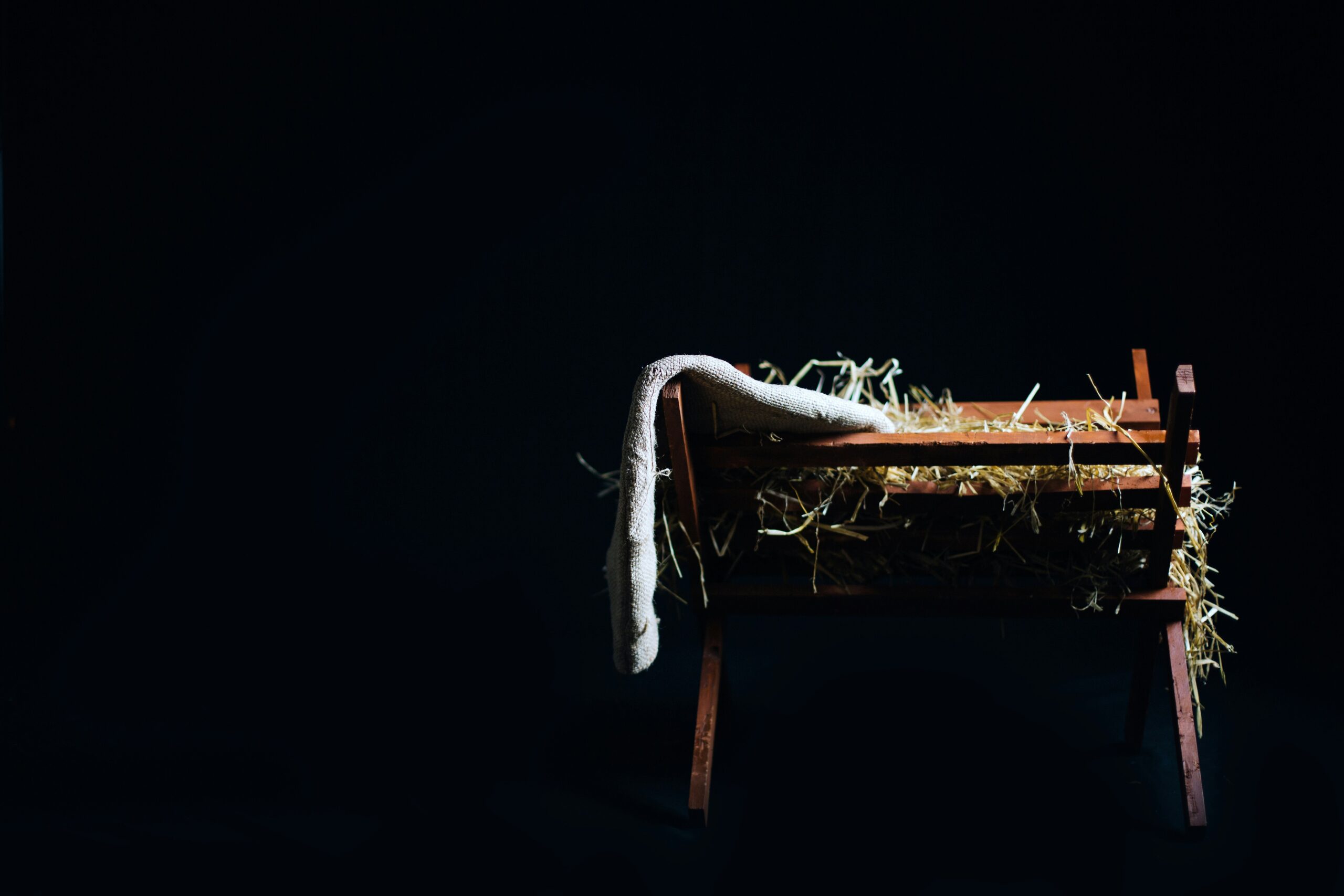
I was once told a story, that somewhere in a Mexican slum (one of the ‘ciudades perdidas’, or ‘lost cities’) there was a destitute old woman who every year would put up an extensive nativity set. The Christ Child was always in the centre, of course, but around him she would place dozens and dozens of figures of people and animals. This was no matched nativity set! None of the figurines were the same, or even in scale with each other: some were only an inch high, others were several feet tall. She just filled the scene with whatever figures she could find. This woman, I was told, didn’t have any formal education. But her actions each year communicated a profound truth: there is room around the manger for all of us. In the incarnation, in becoming flesh in Jesus, God breaks down the dividing walls between us, and draws all people, all creation, together.
When we’re faced with public versions of the Christmas message that feel contrary to this all-inclusive heart of our faith, what can we do? Navigating the complexity of the issues in discerning a faithful response is by no means a straightforward task!
- We want to say No to hostility and division – but we also want to say Yes to flawed human beings, because we know we are too!
- We do want to challenge divisive messages, but we don’t want to unwittingly amplify them.
- We do want to continue focusing on ‘the main thing’ – proclaiming and embodying the good news of the incarnation – but we don’t want to avoid saying challenging things and be seen as tacitly supporting something contrary to the gospel.
- We do want to offer a compelling counter-narrative, but we don’t want to turn this into a competition for attention, volume, numbers – because we’re working with a radically different theology of power.
- We do want to ‘put Christ at the heart of Christmas’, but what we mean by that is very different from the movement of aggressive ‘Christian nationalism’ we’re seeing emerging in our country.
- We do want to affirm our solidarity with refugees and asylum-seekers, but we don’twant that solidarity to be turned into another polarised ‘us vs them’ division that means some of our neighbours hear that we’re not in any sense ‘for them’.
- So we do, also, want to find ways of communicating with those we disagree with (who may well also, already, be part of our own church communities, or coming to church this Christmas hoping to find a spiritual ‘home’) that their struggles, and deepest longings, their ‘hopes and fears’, are met in the Jesus, whose birth we celebrate at Christmas, and whom we try to follow all year round.
People in my parish in Hodge Hill, Birmingham (England) find themselves on the sharp end of national politics. It’s an area that has for decades been economically marginalised, ‘asset-stripped’ of vital public resources, and where employment opportunities are increasingly hard to come by. It’s an area that includes some historically ‘white working-class’ outer estate neighbourhoods (which are now much more ethnically diverse), and where over 50% of local residents are Muslim. We have a hotel that houses asylum-seekers in one corner of our parish – and that hotel has had a number of ‘protests’ outside it in recent months, mostly also local people. And even within our congregation there are, on the one hand, people of African and African-Caribbean heritage who experience racist language every day and feel threatened by the raising of St George’s flags, and on the other hand, people who are feeling ‘unmoored’ by the shifting tides in society around them, and who long for a sense of stability and security that they feel they’ve lost.
And yet, amid the multiple challenges, many of my neighbours – of all different backgrounds, nationalities, faiths and socio-economic status – can tell stories of strangers becoming friends, of difficult conversations and deep listening across political differences, and of working together to challenge injustice and to build community across lines of division. And for those of us who are Christians locally, we have been involved in all of this precisely because we see the incarnation of God in Jesus at the heart of it all.

This is where the generous hospitality of the Mexican señora’s nativity scene comes to our help:
At the heart of the scene is the baby Jesus: God’s power seen in all its fullness, in a small, defenceless, newborn child – the starkest of contrasts with the violent power of King Herod, and the Roman Empire behind him.
The nativity scene is big enough to welcome all who feel excluded and marginalised, whether they be ‘local’, low-status shepherds, or ‘foreign’ magi who have travelled from distant lands. The shepherds and the magi may not be able to speak the same language, they may have nothing in common, but they have been drawn there, together, around the manger, by the God of Love.
The Christmas story is not separate from politics, but is profoundly political: in drawing together the most unlikely, and in embodying a radically different kind of power, it invites us into a space where the ‘world order’ as we know it is turned upside-down (as Mary sings in the Magnificat), and where our supreme loyalty is to the ‘law of love’ (the twin commandments to love God and love our neighbour).

The Rev Dr Al Barrett is vicar of Hodge Hill Church in East Birmingham. He is the co-author of Being Interrupted: Re-imagining the Church’s Mission from the Outside, In with Ruth Harley (SCM Press 2020) and writes at his personal blog, This Estate We’re In.